Published: 01.04.2026
Anežka is 24 years old and recently became one of the youngest deputies in the Chamber of Deputies of the Parliament of the Czech Republic. Thanks to preferential votes from young people, as well as many women, Anežka, who is a graduate of the Faculty of Arts and Philosophy and is continuing her studies elsewhere, got a seat in the Czech Chamber of Deputies. What are her objectives? To open a debate on cryptocurrencies and introduce stricter penalties for domestic violence.
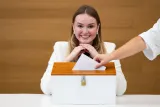
At the beginning of November, Anežka attended her first official post-election meeting of the Chamber of Deputies. Now she already knows her way around the Parliament buildings in Prague’s Lesser Town. Before the elections, getting elected seemed like a distant dream. She was the fifth-listed candidate on the STAN movement’s ballot, with many better-known and more experienced candidates listed above her. Despite such a position, Anežka, who majored in German Language at the Faculty of Arts and Philosophy of the University of Pardubice, stepped up to the challenge – and achieved a sort of election miracle, as she left her four higher-listed colleagues behind. Thanks to more than 3,000 preferential votes, she was elected as number one. When her colleagues congratulated her at the party’s venue for election night at Pernštýnské Square in Pardubice, she had not realised it all yet. On Monday, she saw her face in the newspaper and knew that it was a fact.
Calls that worked
Anežka believes she was successful thanks to calls to vote for 30 candidates below the age of 30 and a call to give preferential votes to 3 candidates below the age of 30, which made her more visible. “My photo was on a billboard in the Pardubice Region. When I was passing by in a car, it felt unbelievable,” says Anežka. The calls aimed to encourage voters to support young candidates below the age of 30 and make the Chamber of Deputies younger. The average age of deputies before the elections was 53, the second highest average in history. What also helped was that young people, as shown by Ipsos surveys, feel underrepresented in politics and want parties to better address their needs and issues such as affordable housing, mental health, innovations in the education system, or tougher punishments for sexual offenders. The campaign called “Circle Women” worked in a similar way and supported greater engagement of women from left to right. Her social media presence, especially on Instagram, also helped her catch the attention of young people and win their votes. This is consistent with the increasing tendency to mobilise young voters in the digital space.
Twelve young newcomers
In the end, there are 12 deputies in their twenties and a record-high number of female deputies. This is an enormous increase compared to the previous elections, when only three young politicians won a seat. “It is great that young voters are finally heard. It is a clear signal that they want more young deputies as well as a shift in direction. It is a new phenomenon – and really amazing, in my opinion,” says Anežka, who continues to study German Language and Literature in Brno after graduating in Pardubice. “I still have one more year of study ahead, but I will give priority to my work in Parliament,” she says decisively. She sees the new job as a challenge and looks forward to it very much. “Hello, my name is Anežka Nedomová and I will be your representative in the Chamber of Deputies in the following four years,” Anežka introduces herself with great enthusiasm.
Do you remember the moment when you learned that you had been elected?
I must admit that it is rather blurry for me. (laughs). I am realistic and pragmatic, so I did not think for a moment that I could jump ahead as a fifth-listed candidate and get ahead of all the experienced colleagues on our ballot, including the lead candidate for the Pardubice Region. When the results started to look promising for me, I called my best friend and asked her to come immediately and join me. When she arrived, I got overwhelmed by all the emotions and intense feelings of the past days, and I broke down. But my friend kept encouraging me and told me what a success it was.
What were your feelings over the election weekend?
Friday was quite normal, but from Saturday morning, people kept sending me messages: that they were keeping their fingers crossed for me, that they supported me, that they hoped I would get elected. I also got photos from the ballot rooms. Suddenly, I was tagged on Instagram much more often, and I kept getting new followers. My posts suddenly had 60,000 and later even 100,000 views. “Mum, come here now. There is something going on, this is crazy,” I kept telling my mother. (laughs) I had some 260 followers before the elections, which is not a crowd that gets you to Parliament. It is far from 3,176 preferential votes...
Do you know who voted for you?
I was supported mostly by young people and women. I did not need to carry out any special investigation after the elections, as the messages I got clearly showed this. About 80% of them were sent by women. And it is really lovely when women support women. We live in a patriarchal world: a man joins another man and they go have a cigar, and while doing so, they discuss what they need. And they tell us women to stay in the kitchen and get them coffee. But they do not want us to interfere. That’s not to be harsh about men; they also supported me. They told me to “give the others a thrashing.”
Why did you decide to run?
I want to live in a democratic country with the rule of law. Thanks to democracy, we can have the interview we are having. Thanks to democracy, we could elect young people as our deputies, and we can show everyone what people can do. I can draw comparisons since I lived abroad in the past; I spent a year in Germany thanks to the University of Pardubice, and also in other European countries. Having said that, I am back in the Czech Republic and I want to build a strong foundation for younger generations. It is a sort of mission for me.
Do you get support from your family?
I do, and I appreciate that. My family has supported me from the very beginning. However, I heard a lot of “buts” after the elections. But you will finish school, right? But you will not give up now? But education is important...
When did you become interested in politics?
It was when I was 14 or 15 that I started to understand what was going on in Czech politics. And it was not a rosy story. I was in the final year of primary school, and we started to discuss politics with my classmates. Then each of us went to a different grammar school, but we still kept in touch, and together we took part in a number of protests; they made me aware of the movement called Million Moments for Democracy, and I quickly understood that democracy is something that needs to be cherished and fought for.
Did you talk politics at home?
Regularly. It was mostly thanks to my grandpa, who made politics a common discussion topic for me. When I had lunch or breakfast at my grandparents’, my grandpa always discussed politics with my grandma and involved me as well. Even though he was not imposing his opinions, I appreciated them as I found them very insightful. My grandpa was born in 1950 and spent part of his life during communism. He experienced the change of regime and, after the Velvet Revolution, got involved in local politics. He served as a deputy mayor in Dašice, a village in the Pardubice Region, and later served three terms as mayor.
Did you want to follow his lead?
He made me realise that local politics is a little bit uncomfortable. People know you, keep watching your family, and you need to deal with many uncomfortable issues. But I was attracted anyway. My original plan was to run in the local elections to be held next year.
Instead, you jumped right into high-level politics...
It was a last-minute decision. Back in March this year, I joined an organisation called Mladí starostové, which is the youth wing of the STAN movement. Then I jumped at the opportunity when those who wanted to run for STAN went out to collect signatures to get support. I needed 400 signatures to be fifth-listed on the ballot. It felt like Survivor. I experienced first-hand what it was like to ask for someone’s signature; as part of that, I often heard what people thought of me, or got into a short discussion about why I wanted to get elected and what I wanted to change, and sometimes got recommendations on what I should focus on once elected.
Once you had the signatures, what were the next steps?
I took part in a regional meeting of STAN in Pardubice. For most of the members, it was the first time they had seen me and they asked, Who is she? or What does she want? But I won their votes with my speech and thus was listed fifth on the ballot.
And the intense face-to-face campaign started...
It was very tough. I faced many uncomfortable situations. I got many surprised, sometimes even unpleasant or slimy looks. Sometimes my appearance caught attention too. When I wore more visible make-up, I often heard people say things like, What will such a Barbie model do in politics... But there were also positive moments – such as discussions with secondary school students and young people. I really enjoyed that.
What topics do you want to work on in Parliament?
I have three main ones. The first is the prevention of domestic violence, including stricter penalties and better protection for children. It is a topic that I feel I owe to the women who voted for me. During the last term, my colleague Barbora Urbanová managed to legislate a list that will prevent those who have abused a child in the past from working with children. That is great progress, and we will join forces in other areas.
My second topic is support for start-ups, aimed at young people and new initiatives. In Pardubice, we have a great organisation called P-Pink, which helps start-ups in the initial phase. I would like to approach them and start some cooperation. It may be an inspiration for another edition of the project called Have an idea? Come and show it to see how we can help.
The third area is cryptocurrencies, where I clearly trespassed onto my colleagues’ ground, as I already hear them say, Hey, you are a woman. Keep off crypto. (laughs) Still, I would like to create a legislative framework for cryptocurrencies and do away with the bad feelings left by the Czech Bitcoingate. I believe that there will be room for all of this in the opposition camp.
Do you plan to bring the Chamber of Deputies and its work closer to people?
Definitely. Many people have misconceptions and do not understand how the Chamber of Deputies works. I would like to open it up and keep people informed. I will be creating videos and showing what we do and how our procedures work.
Do you have a message for young people who think politics is not for them?
My main message would be: Be interested in politics – it is really important. Their future is at stake, and this is the only way to have some control. This is the country where they will live and bring up new generations. They must not be indifferent.
Your agenda is busier and busier... Do you still have time for your hobbies?
I do. Work-life balance is really important. I play the piano, so I devote my free time to music. But I am also a big fan of the Dynamo ice hockey team in Pardubice, so I like watching their games.
Bc. Anežka Nedomová (2001) is a Czech politician, German teacher and interpreter. She was born in Pardubice. She studied German Language at the Faculty of Arts and Philosophy of the University of Pardubice and spent one year at the Friedrich-Schiller-Universität in Jena, Germany, as part of the Erasmus+ programme. She now studies German Language and Literature at Masaryk University in Brno. In 2025, she was elected a deputy to the Chamber of Deputies of the Czech Parliament. In her free time, she enjoys travelling, foreign languages and meeting new people.
TEXT Zuzana Paulusová : PHOTOS Adrián Zeiner
This text is available in the exclusive edition of the University of Pardubice magazine MY UPCE, in both print and online versions.