Published: 19.06.2026
While his classmates were busy preparing for prom, he was busy programming a robot for an international competition. He later had to cut nearly a third of his thesis because it was “too long”. And when his younger brother needed equipment for his science projects, he simply built him a custom microscope. When Jakub Ešpandr from the Faculty of Economics and Administration takes on a project, he refuses to settle for “good enough”.
A pair of FEA students recently created a 3D haptic model of the Mydlářovský House in Chrudim – home to the Museum of Puppet Culture. The 1:55 model is now part of the museum’s tactile exhibition, allowing visitors with visual impairments to explore the building through touch. Jakub and his classmate Martin Fiebinger divided the work: Martin handled the design, while Jakub took charge of the 3D printing. And printing is something Jakub knows well: he routinely prints components for his robots, drones, cameras and even microscopes.
“Printing the house and all its ornaments took over 200 hours. The post-processing took another hundred – gluing the model together, sanding the joints so they wouldn’t show, and applying the final paintwork. At that point I had no idea what ‘haptic’ even meant, but my gut told me to use a more durable paint. When I later learned the model was meant to be touched, I was relieved I’d chosen a paint used for German military vehicles – it can withstand almost anything,”
Jakub laughs.
What’s that case you’re carrying?
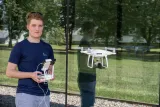
I keep my drone in it. I used to transport it on the back seat of my car, and… well, one day it fell over and got damaged. So I built a case. It started as a regular transport box, but I modified it based on my own design. Some parts I printed on a 3D printer – simply because you can’t buy them anywhere. The result fits my needs exactly, so I’m happy with it.
Do you carry it around often?
Only when I’m in the mood to fly, or when I want to film or take photos. Recently I even brought a couple of drones to university and showed them to my thesis supervisor and several lecturers, because my thesis focuses directly on drone-based remote sensing.
When and where did you last fly your drone?
That was still in Taiwan – I came back from my internship there in mid-June. I spent four and a half months there, but only managed to go on three trips. I tried to use the time mainly for my own development. And after returning home, I barely had time to fly here too – my thesis kept me fully occupied until I defended it at the end of August. I complicated things a bit by including seven case studies comparing 60 models.
Isn’t that more like a dissertation?
Theoretically, maybe yes. Some parts genuinely look like a PhD thesis. That’s kind of my reputation at the faculty. (laughs) If a seminar paper was supposed to be eight to ten pages, mine had 70. My classmates don’t even bat an eye anymore.
Do you fly any special type of drone?
My favourites are the ones I build myself. This one too. I hardly use anything else nowadays. I have specific requirements, and the only drones that meet them are the ones I make. (laughs)
How are your drones different from the standard ones on the market?
Commercial drones are made as universal machines for a mass audience. Mine aren’t. Each of my drones is custom-built for a specific purpose. I can push the performance further and fine-tune the parameters exactly as I need – speed, stability, payload capacity for cameras or custom sensors. As a result, they can do things you simply won’t get from regular store-bought models.
When did you build your very first drone?
Drones became popular in the Czech Republic around 2013, when the first communities started forming. I built my first one in 2012. I ordered the components from the Netherlands and China and made the frame out of wood. By then I already had experience with robotics, electrical engineering and electronics. I originally started by building and programming robots for competitions – first using specialised LEGO Technic kits, and when even those weren’t enough, I printed my own components on a 3D printer.
So how do you actually build a drone?
First, I design the frame in CAD [Computer-Aided Design] and run simulations of the expected flight parameters – that helps me choose the right electronic and motor components. Then I print a prototype on a 3D printer to verify the tolerances. The final frame is cut from carbon fibre on my CNC [Computer Numerical Control] machine. Then comes the assembly, wiring, soldering of electronic parts, and finally the software tuning. For that, I use my own software that analyses the drone’s flight-log data – its “black box”. After many hours of fine-tuning, the drone is finally ready to fly. Besides standard cameras, I also mount custom equipment – I even built my own multispectral camera for academic research. It’s still a work in progress and needs plenty more tweaking.
Do you build drones on commission?
I do. I created a brand – Born4Flight. It’s a small startup I’d like to develop further. The idea is to offer complete design, development and production of custom FPV [First Person View] drones – both for individuals who want a unique machine and for companies or media teams that need specialised equipment for filming, surveying or other projects.
And what do you personally film with your drones?
I love bird’s-eye views. They’re the only way to get truly original shots. But what I enjoy most is experimental photography – macro and micro photography. You can really experiment with it and develop a distinctive style that people immediately recognise. It’s not something everyone does – you need specific knowledge, experience and specialised gear. And now I’m also getting different requests: recently I filmed the junior motocross championship, for example.
When did you actually start taking photos?
I first held a camera when I was three or four – and immediately took it apart. (laughs) I’ve been into photography since primary school. I loved capturing little moments and documenting trips. In secondary school, I bought my own camera and joined the photography club. I even represented the school in a photo competition with my macro shots of animals, architecture and various experimental images.
Have you ever won any awards for your photos?
Yes, quite a few. I repeatedly placed in FotografRoku, a competition organised by FotoVideo magazine, and some of my photos even made it into the print edition. In 2017, I won first place in the Technology Around Me competition run by the Prague Science & Technology Society for a short documentary film. One of my photos was also selected by SAAL Digital for large-format printing as part of a photo contest. That really gave me a boost – that moment when recognition starts coming in.
What does your photography gear look like?
It depends on where I’m going. While most people try to make their equipment lighter and smaller, I carry a photo backpack that weighs around twenty kilos. I take the gear I trust: Canon professional DSLRs paired with several lenses, from wide-angle to telephoto. I know I can rely on them: battery life, shutter durability, and overall performance. And they handle dust, rain and rough terrain without any issues. And if something does break? I fix it myself. I’ve repaired faulty lenses at home several times.
Do you repair cameras for others too?
Yes. Friends know they can always come to me – and word has spread. Recently, a film production company from Slovakia contacted me because they had damaged a specialised €4,500 camera and couldn’t find anyone who would repair it for a reasonable price.
And do you specialise in anything else?
Thanks to my younger brother, who has been into biology since primary school, I started getting deeper into microscopes. The ones we had at home didn’t always meet our needs, so I began experimenting – modifying them, upgrading them, adding new components. I added options for microphotography and various lighting techniques. It helped him enormously with his biology studies and sample documentation.
So that’s what pulled you into optics?
Exactly – microscopes and optical instruments in general. Over time we started buying older models, watching auctions and hunting for parts across the globe. We received parcels from Ukraine, Uzbekistan, Australia, the US… eventually we built an entire collection. And yes – I can fully refurbish them. I disassemble the entire microscope, clean the optics, repair or replace faulty parts, then reassemble and realign everything. That can get complicated, especially with models from the 1940s or 1960s.
Why is that?
Because documentation for those models is nearly impossible to find today. I even wrote directly to the manufacturer – and they replied that back then, only three specialists in the world knew how to service the instrument. Their advice? Trial and error.
And you managed…
I did – and it didn’t even take that long. That’s when I decided to create missing manuals for older microscopes. I keep a catalogue of all my microscopes online, complete with photos and descriptions – a kind of virtual museum. By now, I have one of the largest personal collections of manuals and publications on microscopes.
It sounds like you approach everything your own way.
That’s probably true. I tend to do things differently, in my own style. It was the same in secondary school. When I built a robot that won the Czech round of a competition, I was already working on another robot I was supposed to take to the world finals. I programmed it using Arduino – and ironically, I was failing that subject in school. (laughs) In competitions, it often happened that I taught my robots far more tasks than required, or described their programming in an overly sophisticated way. My challenge is that I find it hard to do something “just simply” when I know it could go much further. It feels wasteful to stay on the surface.
Where are you heading now?
I always try to find a niche and significantly improve it, even if the result will serve only a small group of people. I enjoy pushing things forward. My dream is to design and build my own products, or create tools that people can genuinely use to develop their own skills. For example, my fully automated photography system: it consists of three components I designed and built myself – a macro rail, a micro rail and a control unit. All the user does is enter the starting and ending positions and choose the step size or number of shots. The system takes over and produces a sequence of perfectly sharp images. I’m also focusing on drone software because I want complete independence from third-party apps – so I’m developing my own tools with features I always wished commercial apps had.
You build robots, drones, repair optics and microscopes. What’s next?
Hard to say. I’ve just applied for the doctoral programme in Applied Informatics, so I’m curious to see what challenges await me. I’m specialising in a few areas, but I still aim to remain versatile. Right now, I’m investing above all in personal growth. I think that’s the best thing I can do – build the broadest portfolio of skills possible. Because what you develop while you’re young is exactly what you can draw on for the rest of your life.
TEXT Zuzana Paulusová : PHOTOS Adrián Zeiner
This text is available in the exclusive edition of the University of Pardubice magazine MY UPCE, in both print and online versions.